

The Woman Who Held the Stage for Everyone Else
For seventeen years, Gaëlle Voukissa has been the actress standing just outside the spotlight — steadying Racine, Shakespeare, Rostand, and one very nervous Richard Anconina. Paris has yet to notice.
Drivers on the avenue de Marigny hit the brakes.
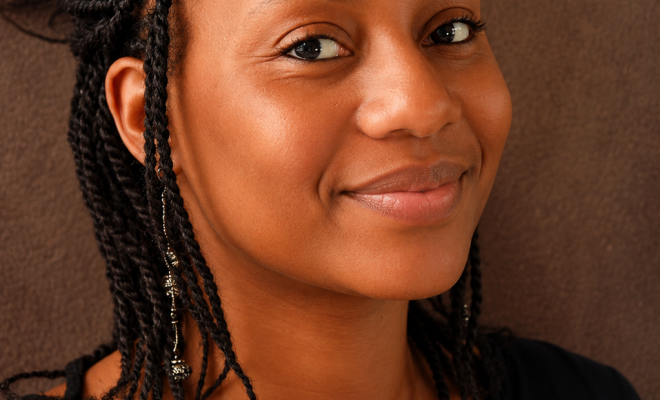
It is September 2021, and there is a woman standing outside one of the most beautiful theatres in Paris in full police uniform. She is striking. She is also, at that precise moment, one of the least-known working actresses in French theatre — which is the kind of contradiction that makes a career worth telling.
Her name is Gaëlle Voukissa. Inside the Studio Marigny, Richard Anconina — 68 years old, thirty-plus films, a career built on Claude Berri and Claude Zidi — is about to walk onto a stage for the first time in his life. He is terrified. And the person talking him down is the woman on the pavement.
“Don’t worry, Richard. Being tired, having doubts — that’s normal.”
He repeats the line to a reporter, almost verbatim, as if it were a talisman. He says he got lucky. He says she comes from the theatre and has plenty to teach him. It is, to this day, the most widely circulated sentence Gaëlle Voukissa has ever spoken in public — and she said it to somebody else, in a dressing room, about fear.
The résumé nobody reads out loud
Here is a partial list of the people who have directed her.
Jean-Louis Martinelli, at the Théâtre Nanterre-Amandiers. Isabelle Nanty. Igor Mendjisky. Lazare Herson-Macarel. Jérémie Lippmann, a double Molière winner. Cédric Jimenez, on a €42 million science-fiction thriller that opened out of competition in Venice.
Here is a partial list of the actors she has shared a stage or a set with: Anne Suarez, Richard Anconina, Eddie Chignara, and — at one remove, on the same production — Gilles Lellouche and Adèle Exarchopoulos.
And here is the number of press profiles written about her in seventeen years: one.
That gap is the story.
Trained by the hard road
She came up the way the serious ones do. Cours Florent in 2006. The Classe Libre — the school’s fiercely selective free programme, the one that turns out Comédie-Française pensionnaires and César nominees — in 2009, under Jean-Pierre Garnier.
Then she made a choice that no career strategist would have recommended: she went where the language was hardest and the money was worst. Musset twice, with Garnier. Falk Richter’s fractured German prose in Trust, in a hundred-seat house in Ménilmontant. Prévert and Desnos in a surrealist cabaret. Contemporary Moldovan playwrights, which is not a sentence anyone writes for the résumé.
In 2013, two doors opened in the same year — a career’s worth of luck arriving at once.
Isabelle Nanty cast her in Eve Ensler’s Mango at the Théâtre des Mathurins. And Jean-Louis Martinelli, in his final season running Nanterre-Amandiers, put her in Phèdre.
She played Panope. Roughly thirty lines. Phaedra’s attendant. The role you take when the answer to “do you want to be in a Racine at a national theatre” is obviously yes.
The production was not well received — one Paris critic pointedly declined to rank it among Martinelli’s best. Voukissa was not named in the reviews, for good or ill. That is what happens to attendants.
Three years inside a troupe
Then came Cyrano, and this is where you understand what kind of actress she actually is.
Lazare Herson-Macarel’s staging with the Compagnie de la Jeunesse aimable was a deliberate provocation: ten actors, two musicians, fifty characters, two thousand lines of verse. The director called it a feast <cite index=”30-1″>”of words, of intelligence, of vital energy”</cite> — a manifesto for ensemble theatre in an age of star vehicles.
Voukissa was in it from the 2017 creation, through the residency at the Théâtre de la Tempête in the Cartoucherie de Vincennes in late 2018, into the 2019–2020 tour. Three seasons. Multiple characters a night. Reviewers praised the company as a single organism, unified and galvanised, and reserved the individual raves for Eddie Chignara in the title role.
That is the bargain of ensemble work, and everyone in it knows the terms. You get a craft. You do not get a name.
Two years later she was doing Shakespeare in Anckaert’s Measure for Measure on tour — alternating the role with another actress, a detail that tells you exactly where she sat in the pecking order, and exactly how much she wanted the work.
Two seasons opposite a man learning to breathe
Coupable changed the scale, if not the billing.
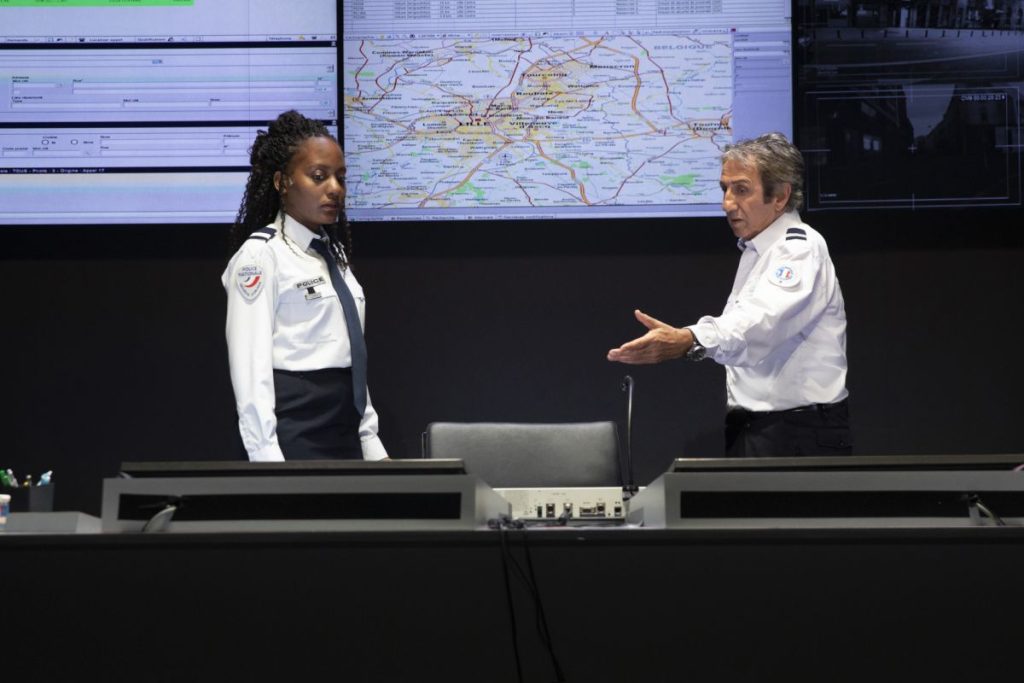
Jérémie Lippmann’s adaptation of the Danish thriller Den Skyldige is a near-monologue: one policeman, one switchboard, one night. Anconina carried it. Voukissa played Major Zanetti — his commanding officer, his only flesh-and-blood scene partner, and the sole source of friction in ninety minutes of telephone dread.
It is the most thankless assignment in theatre. Enter, contradict, exit. All the tension belongs to the other person.
And yet it was this role that finally put her in print. One critic noted that she plays the officer <cite index=”120-1″>”with considerable authority”</cite>, adding that she has admitted the part is not an easy one and that she holds it exactly as it should be held. Another outlet mentioned her only in parentheses, as “his supervisor.” That parenthesis-to-compliment range is the entire bandwidth available to a supporting actress in France.
The show ran more than 200 performances for over 100,000 people, from the Studio Marigny to Marseille and back for a final run in December 2022. Two seasons. Six nights a week. No award, no nomination, no follow-up profile.
The Congo detour
Somewhere in there she went home — or to a version of it.
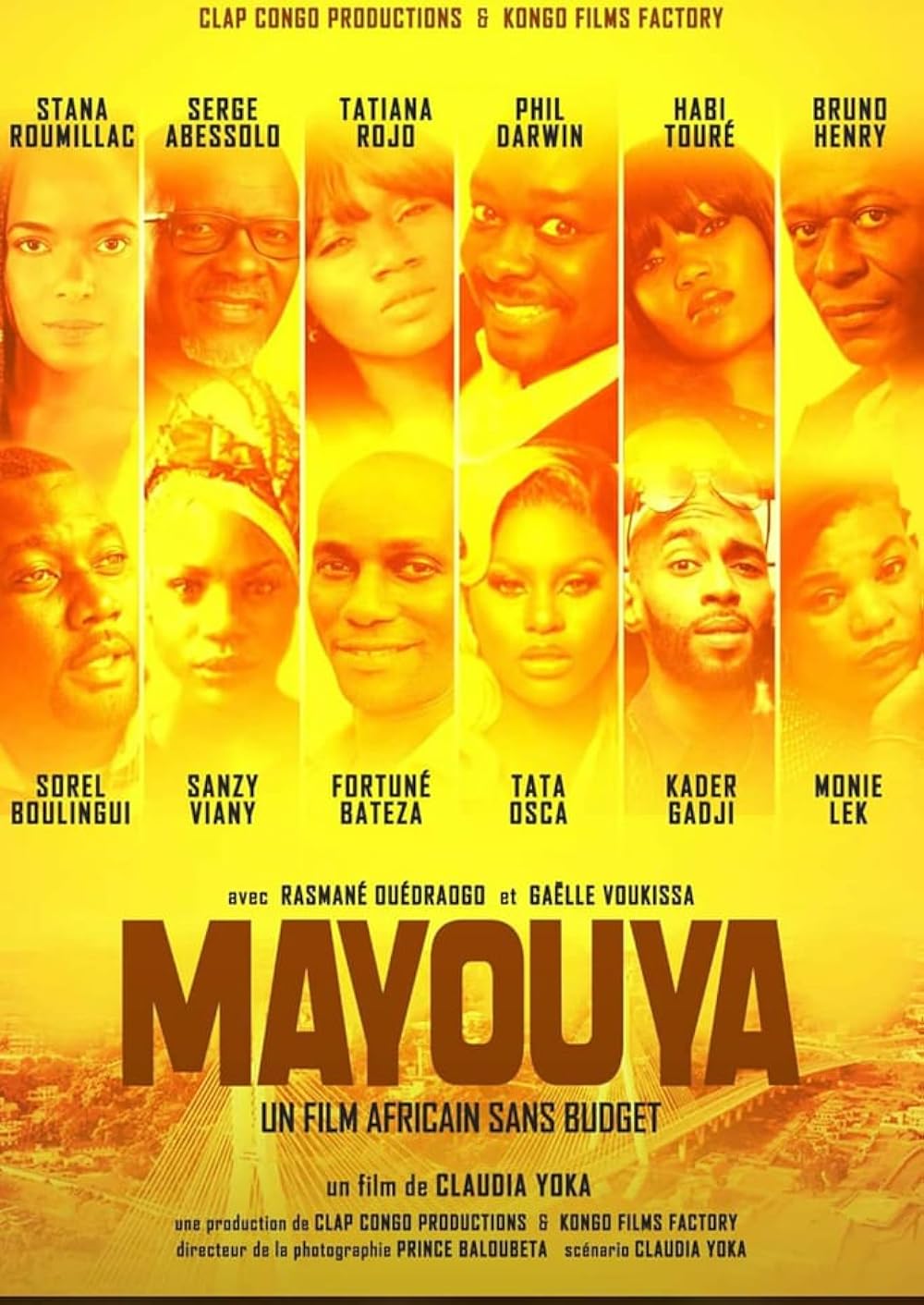
Mayouya, directed by Claudia Yoka, is a Congolese comedy about a filmmaker who cannot raise money and is propositioned by her banker. Yoka assembled what she has described as an <cite index=”20-1″>”exemplary and, above all, pan-African”</cite> cast, drawing performers from Senegal, Côte d’Ivoire, Gabon, Burkina Faso and Congo. Voukissa, who lists Lari — a language of southern Congo-Brazzaville — among her fluent tongues, belonged there by more than casting convenience.
A critic reviewing the film’s Canadian premiere at Montréal’s Vues d’Afrique festival in 2023 called her appearance a lovely surprise for anyone who follows African cinema, while describing it as a cameo.
The film won the Best Actress prize at the Dakhla Film Festival in Morocco that year. Worth being precise about this, because it circulates loosely: the award went to the film’s actresses collectively. Yoka herself has said the jury was honouring the subject and the ensemble’s playing. A real prize. A shared one.
Where she is now
October 2025: Chien 51 opens, Cédric Jimenez’s dystopian thriller, the most expensive French production of the year after Luc Besson’s Dracula. Lellouche, Exarchopoulos, Louis Garrel, Romain Duris, Valeria Bruni Tedeschi. Voukissa appears as Léo’s mother — in the full credits, not the press notes. The film split critics down the middle.
Then, quietly, the detail that a novelist would be embarrassed to invent.
TF1’s forthcoming six-part series Marie-Line, incognito, shot across the Cantal from June to October 2025, stars Isabelle Nanty — the same Isabelle Nanty who directed Gaëlle Voukissa on a Paris stage in 2013. Twelve years later, they were back on the same production. (The shoot was suspended for several weeks after Nanty was injured in a road accident in September; the series is in post-production and has not yet aired.)
In an industry that either calls you again or forgets you existed, being called again after twelve years is not nothing. It may, in fact, be the whole point.
The thing nobody has done yet
Gaëlle Voukissa can do Racine, Shakespeare, Rostand, Falk Richter, a boulevard musical and a €42 million sci-fi thriller. That range is genuinely rare, and it cannot be faked.
She has also never played a lead, has no recurring television role, and has given exactly one newspaper interview since 2009.
Talent was never the missing piece. The missing piece is that almost nobody has asked her anything.